A whole world built on the evidence — its ages, its lands, its peoples, its mysteries. And a covenant most world-builders never make.
Recorded history is a thin film on the surface of a 300,000-year ocean. The textbook reads the film and says "it began here." This world says: beneath the film lies a depth — and in that depth were dawns we do not remember. In the Ice Age the seas stood 120 metres lower, and the warmest, richest land — now seabed — is where people gathered first.
How it all was, in order. Dated where the evidence allows.
Tens of millennia of minds like ours — burial with ochre, engraved bone, star-reading, ocean crossings. Progress flickered and was repeatedly reset by small catastrophes.
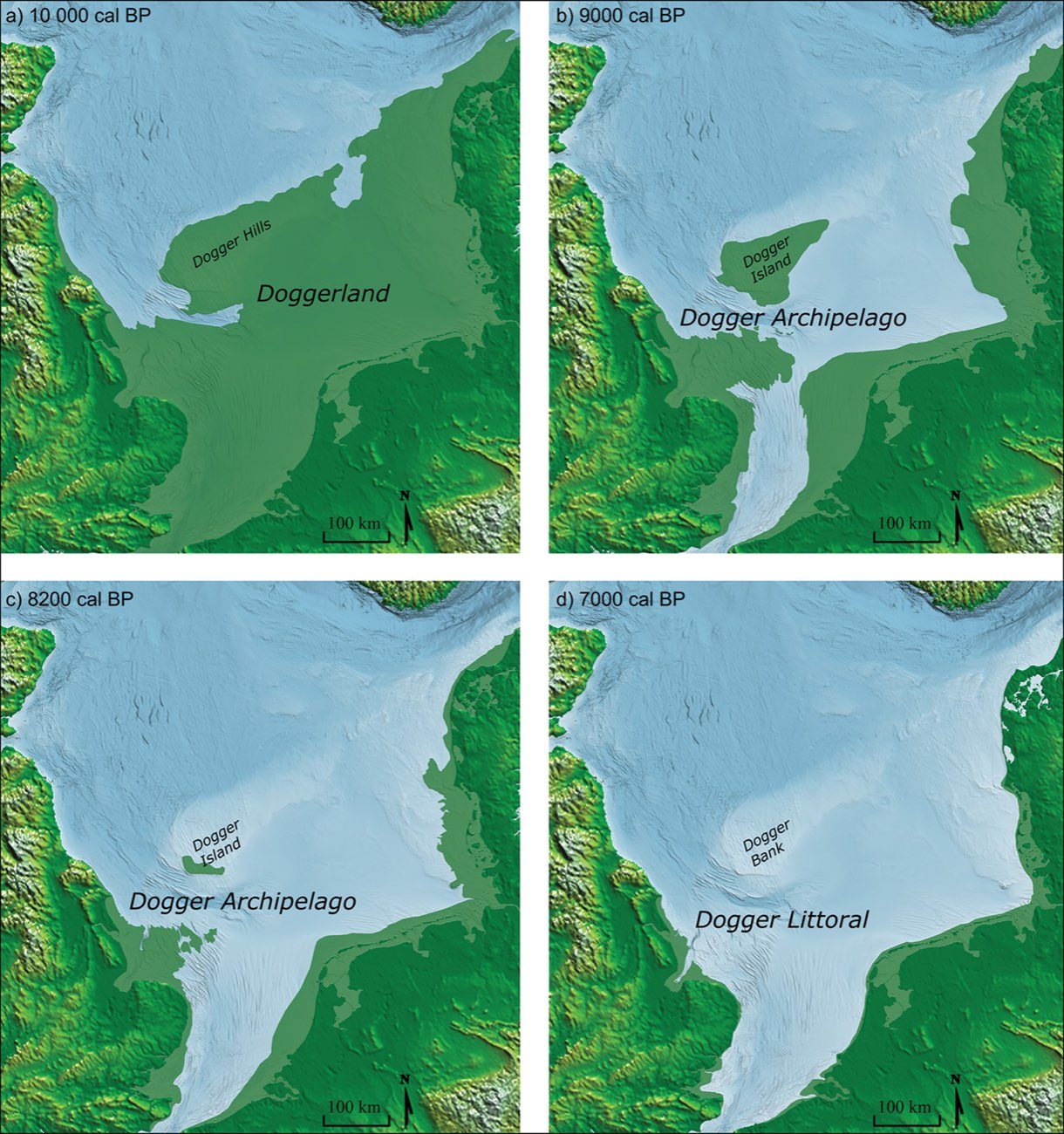
■ / □Warm lowland coasts — Sundaland, Doggerland, the Persian shelf — become the cradle. Here, by our reading, complexity first gathers: villages, seafaring, sky-watching, craft. The "golden age" later remembered as the age of gods. No ruins survive — they are underwater. The world's deepest wager.
□ / ◇The Younger Dryas: an abrupt cold shock, meltwater megafloods, and the rising sea drowns the Great Coast over generations. On every continent, one wound of memory remains — the Flood.
■ event · □ readingSurvivors climb to high ground (Anatolia, the Caucasus, the Andes), carrying not cities but the portable: the count of days, the names of stars, how to raise stone — and one phrase, "it was different before." They are received as teachers.
□ / ◇On an Anatolian hill, rings of carved pillars rise — Göbekli Tepe, before pottery or farming. Not a beginning from zero, but a second morning: surviving knowledge carved back into the one thing that cannot be washed away — stone.
■The teachers die; their methods splinter into ritual, ritual into religion. A priest aligns a pyramid to true north and no longer knows the skill once belonged to those who fled the sea. Memory settles into myth. We are the Inheritors-who-Forgot.
□The now-drowned shelf — Doggerland, Sundaland, the Persian oasis, the Black Sea shore. Real in its parts (Doggerland, Atlit-Yam ■); the heart of the world by our reading.
■ parts · □ heartHigh ground beyond ice and flood: the Anatolian plateau (Göbekli, Karahan), the Andes, the Zagros & Caucasus highlands. Where the Scattering came to rest.
■ / □Where knowledge was re-fixed in stone: Göbekli Tepe & Taş Tepeler ■, later Nabta Playa, Giza, the Maya cities — nodes of sky-memory.
■The ocean itself, risen 120 m — the world's great archive and its great destroyer. Submerged villages (Atlit-Yam) are real ■; famous "sunken cities" (Yonaguni, Cambay) are contested ◇.
■ / ◇A drowned subcontinent off SE Asia — a prime candidate for a populous lost lowland, now seabed. The eastern mirror of Doggerland.
□Tiwanaku & Puma Punku on the altiplano — virtuoso stonework whose full method stays an open question; a Refuge that kept the craft.
□ · craft ◇The folk of the Long Dawn — real, ancient, capable, scattered and few. The 300,000-year foundation.
■Dwellers of the Great Coast — the most developed of their time; remembered, in fragments, as the first people of the golden age.
□ / ◇Survivors carrying knowledge after the Breaking. In history, expert refugees; in memory, "gods descended" — Oannes, Viracocha, Thoth. Here, "gods" = humans bearing the lost — not aliens. (Paleocontact stays ◇ frontier.)
□ · contact ◇Those who, in the Refuges, carved memory into stone — the hunter-gatherers of Göbekli, the master masons.
■Every later civilization repeating the rites without memory of their source — Egypt, Sumer, the Maya… and us.
□Not a people but a process — the slow fade of technique into ritual into "superstition." The reason the world looks empty when it was only drowned and forgotten.
□Reconstruction-pictures: plausible, but not protocol. Here we build the world — and say so. ◇ imagined
Reed boats slip out across a strait that no map shows today — it became seabed. On the sand, stones are laid to the star that rises before the sun: a calendar of sowing and of fish. The elders know the names of forty stars. No one calls it science. It is simply how one lives.
First the cold, sudden and out of season. Then the water — not one wave, but a slow, unrelenting rise: each decade the shore is nearer, the estuaries turn salt, the paths drown. Those who understood early leave, carrying rope, the count of days, the names of stars, and one sentence they will repeat for ten thousand years: it was different before.
On an Anatolian hill the clans gather — still hunters. But among them lives the memory of how it was. And they do what they "should not" know how to do: they raise sixteen-tonne pillars and carve on them the beasts and the sky. Why? To anchor memory in what cannot drown. Göbekli is not a temple of harvest — it is an anchor against forgetting.
Nabta Playa (~4800 BCE, older than Stonehenge), the Maya Venus tables (583.92 days), the Great Pyramid's true-north to arc-minutes. The sky is the most portable knowledge — it survived first.
■Göbekli's pillars ■; the 800–1,650-tonne logistics of Baalbek — a genuine open engineering question.
■ / openTube-drilled granite, micro-fitted polygonal walls, lathe-perfect vases. Small scale reproduced by hand (Stocks); "lost machines" stays a frontier, not canon.
◇ frontier (D)A geared bronze computer ~150 BCE, then nothing like it for 1,400 years. Proof of the world's first principle: high sophistication can be real, and can vanish almost without trace.
■ the calibrationThe frontier — the "magic" of this world. Held as questions, never as answers. ◇ imagined
Three levels: skilled pre-industrial (canon), lost high-tech (D), contact (D–E). The driving question.
◇"Blue-blooded" royalty — memory of beings with copper-based blood (a prior earthly line, or contact) under a different ancient air? Honestly, standard chemistry runs against the literal reading; held as the question "was the ancestral world other?"
◇ (D / sub-E)An Italian radar survey (2025) claims shafts and great cubes hundreds of metres down. Unreviewed; the test is drilling and independent geophysics.
◇ (D)Any ◇ mystery becomes canon only through one period-anomalous artifact from a securely dated, undisturbed layer, irreproducible by the era's means — the Antikythera standard. To date, nothing has breached it (0 of 12 classic out-of-place artifacts; 0 of 5 on independent AI review). The Wall is this world's magic system: strict, honest — and therefore believed.
Deep origins (people enough) → Interruption (catastrophe + 120 m erased the Coast) → the Knowledge Cycle (lost on collapse, carried by survivors). Everything follows from these.
Dates always move earlier, never later — the signature of a model that was set too late.
Absence of ruins is the expected result of a flood, not the absence of history — and it is testable: search the shelf.
Only the proven becomes canon; the imagined wears the ◇ mark. The law that makes this world stronger than fiction.
Flood, teacher-gods, the golden age — not invention, but the memory of the Breaking and the Transmission, archived in story.
Descend through the ages, or open the evidence the world is built on.